

Will AI Rewrite All the Software? The Hard Part Is Proving It
Rauch says AI will rewrite all human-made software and formally verify it. The first half is true. The second half is where software engineering actually lives.
On 5 November 2026, Guillermo Rauch, the co-founder and CEO of Vercel, posted that in the coming weeks and months we will all learn that most human-made software was really slow, had many security vulnerabilities, and was under-specified and incorrect. AI, he said, will rewrite it all, many times, making it fast, cost-efficient, and secure. It will think about failure modes we could not wrap our heads around. It will prove, formally verify, load test, and harden. It will turn memory-unsafe foundations into robust, optimized ones. And if you ask, it will document it, teach you about it, and make diagrams, animations, and slide decks. "In many ways, we are witnessing the true birth of software engineering."
The post travelled fast, hundreds of thousands of views in a day. It is worth taking seriously, not because Rauch is a neutral observer (he runs a company that sells the AI coding future), but because the claim splits cleanly into two halves, and only one of them is true in the way he means it.
The half that is true
Most software is slow. Not all of it, and rarely for one reason. The slowness is usually accumulated: abstraction layered on abstraction, database queries written without ever looking at the query plan, work repeated because nobody measured where the time goes. The code works, so nobody profiles it, and the slowness becomes part of the furniture. For AI-built sites the fixes are concrete: the 20-fix checklist for a slow vibe-coded site starts with images, N+1 queries, and missing indexes.
Most software is insecure. The sharpest version of this is memory safety. Microsoft has said that around 70 percent of the vulnerabilities in its products are memory safety issues, and Google has reported a similar share for Chrome. That is the cost of building the world's infrastructure in languages that let a program read and write memory it should never touch. But the ordinary version is just as common: injection bugs, broken access control, secrets committed to code, dependencies nobody updated. Security work is maintenance work, and maintenance is what gets cut first.
Most software is under-specified. This is the least visible of the three, and the most important. The behaviour of a system usually lives in three places: the code, the tests (if they exist), and the heads of the people who built it. Requirements are written once and then the system keeps changing. Edge cases are discovered in production, fixed quietly, and never written down. Ask a team to describe exactly what their system does in every case and you will get a shrug, not a document.
The rewrite trap
Rauch's answer to all three is the same: AI will rewrite it all. This is where the claim gets dangerous, because rewrites are the oldest trap in software. The value of old software is not the code. It is the behaviour. Every edge case, every weird input that once broke production, every rule a domain expert insisted on, every bug-for-bug compatibility that another system depends on. That knowledge is embedded in the old code, and a rewrite throws it away and starts relearning it from scratch.
The industry has a famous cautionary tale here. In the late 1990s Netscape decided to rewrite its browser from scratch instead of fixing the existing one. The rewrite took years, the company lost the browser war while it was happening, and the essay it inspired, Joel Spolsky's "Things You Should Never Do" from 2000, is still the best argument against rewrites ever written: you throw away years of bug fixes and relearn them one user complaint at a time.
There is an older name for the same idea. Chesterton's fence: never tear down a fence until you understand why it was built. Old code is full of fences. A function that looks pointless is often load-bearing. A check that looks redundant is often there because someone once lost data without it. The spec for a rewrite is the old system, and the old system is the thing you are trying to escape.
AI makes the rewrite cheaper to produce, which makes the trap more attractive, not less. A model can produce a fresh codebase in an afternoon. What it cannot do is know which of the old behaviours matter. It will produce confident, clean, plausible code that drops edge cases silently, because the edge cases were never written down. That is exactly the under-specification problem from the first half, wearing a new costume.
Verification is the bottleneck
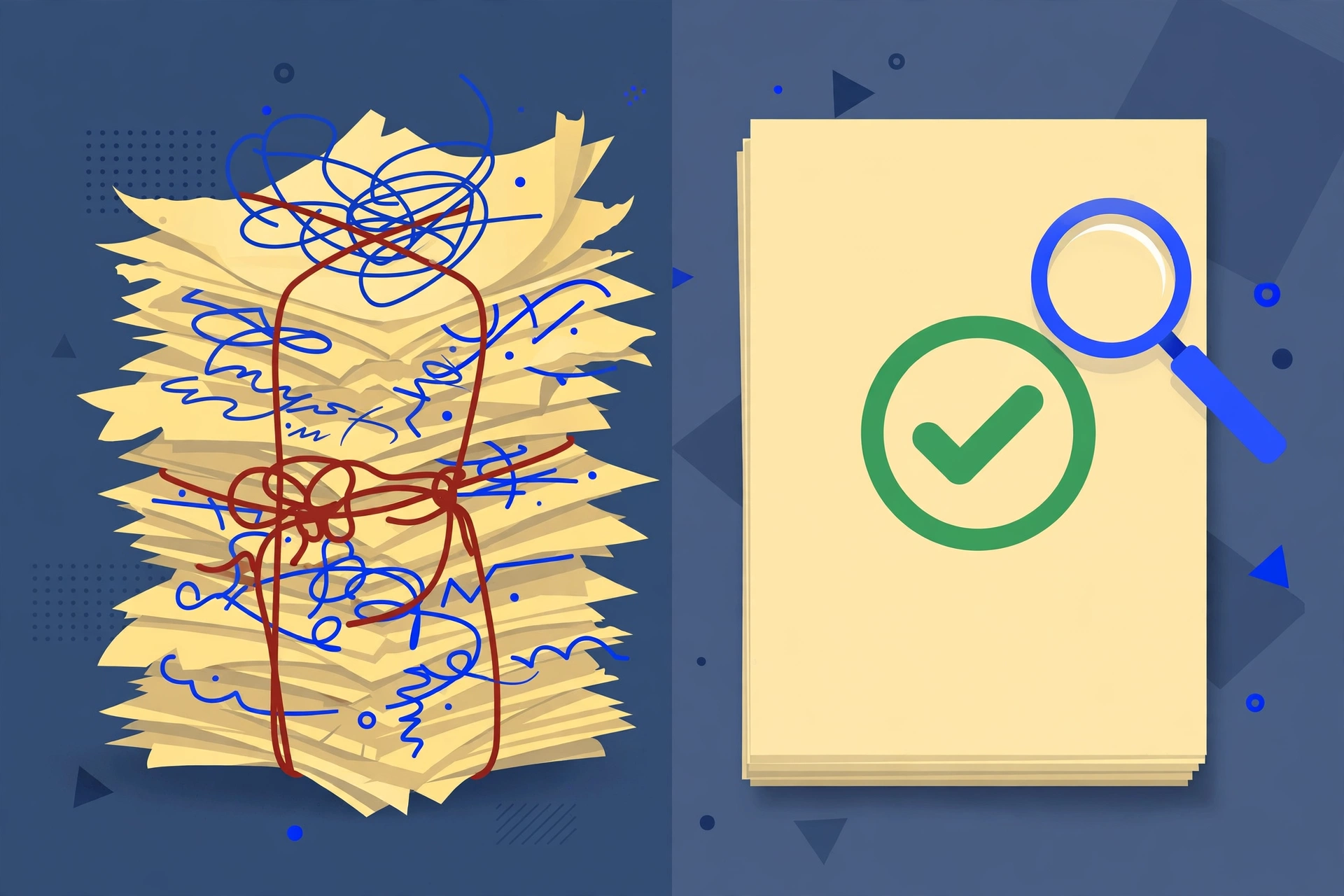
Rauch's answer to that objection is verification: AI will prove, formally verify, load test, and harden. Formal verification is a real thing, and it is worth saying what it means. It means proving, with mathematical rigour, that code does what its specification says, for all inputs, not just the ones you tested. Where it works, it works beautifully. The seL4 microkernel was formally verified. The CompCert C compiler was formally verified. These are genuine achievements.
But notice what they have in common: small, stable, high-value cores, built by specialists, over years. Verification does not scale to arbitrary applications for a simple reason: the specification is the hard part. To verify a system you must first write a complete, correct specification of what it should do. And the specification is usually where the bugs live. If you could write a perfect spec, you would already have solved most of the problem.
Most software has no formal spec at all. Its behaviour is defined by its tests, its users, and its history. There is nothing to verify against except the old system, which brings us back to the rewrite trap. AI can help write specs and even help write proofs, but generating a proof is a different problem from generating code. A wrong proof is worse than no proof, because it carries the authority of a proof. Checking an AI-generated proof requires either a proof checker, which only works when the spec is formal and complete, or a human reviewer, which puts the human back in the loop as the bottleneck.
Load testing and hardening are real and useful, and AI can genuinely help with both. But they are testing, not proof. A load test tells you the system survived the load you tried. It does not tell you it will survive the load you did not try.
The job moves, it does not disappear
The part of Rauch's post that is right is the shift it describes, even if the conclusion is wrong. When writing code becomes cheap, the scarce work is specifying what the code should do and checking that it does it. That is not the birth of software engineering. That is what software engineering always was: tradeoffs under constraints, with verification as the discipline that keeps them honest. AI just makes the writing cheap, so the engineering becomes the whole job.
In practice that means the skills that matter most are the ones that look least like coding. Writing a precise specification before generating anything. Designing tests that pin behaviour, including the error paths, the concurrency, and the access control, not just the happy path. Reviewing AI output for behaviour changes rather than style. Keeping the old system as the test: characterization tests that record what the old code does, golden tests that compare the new output with the old, and a human who understands the domain deciding which differences matter.
This is also why "use AI, just don't ship slop" is the right rule for the moment. The slop is the unverified part. AI-generated code that nobody read, tested, or compared against the old behaviour is slop, however clean it looks. AI-generated code that was specified, tested, and reviewed is just code.
What to do instead
If you are using AI to rewrite or generate code, the order matters. Spec first: write the behaviour down before generating anything, including the edge cases you already know about. Keep the old behaviour as the test: record what the current system does before you touch it, and compare. Review diffs for behaviour changes, not style. Verify the edges: error paths, concurrent access, authentication and authorization, and the inputs your users actually send, not the ones in the demo.
And do not rewrite working systems to chase the rewrite. Rewrite the hot spots: the slow path that profiling actually blames, the unsafe core that handles untrusted input, the module whose behaviour nobody can explain. That is where the payoff is real, and it is a small enough surface to specify and verify properly.
Rauch is right that a lot of software deserves to be rewritten, and AI makes that cheaper than it has ever been. He is wrong that the rewrite is the hard part, and wrong that verification comes free with it. The birth of software engineering is not the moment AI writes the code. It is the moment we admit the code was never the hard part. The hard part was always knowing what it should do, and proving that it does it.
Share this article
Newsletter
The NotVibesCoded Weekly
One email a week: the newest articles, project teardowns and AI-coding notes. No slop, no spam, unsubscribe anytime.
We will send a confirmation email. Click the link in it to finish subscribing.
Written by
NotVibesCoded is written and reviewed by its editorial team under the standards in the editorial policy. A named author page, with full credentials, replaces this placeholder shortly.
Related
Projects mentioned
 Claude Code
Anthropic's agentic coding tool that works in your terminal.
Claude Code brought the agent loop to the command line: it reads your codebase, plans changes, runs commands, and iterates, with you directing, not typing. The reference implementation of terminal-native AI engineering.


Related
Related articles
AI wrote your migration: trusting database changes you didn't write
Agents write migrations fast, and database mistakes are the ones you can't roll back from coffee. What to verify before an AI-generated migration touches production data.
Amazon Pushed AI Coding Hard, Then Made Senior Humans Sign Off On It
Amazon mandated senior sign-off on AI-assisted production changes after outages linked to its own AI coding tools. What happened, what the mandate covers, and what it means for every team using AI to write code.
From API wrapper to observable agent: how companies actually build their own AI
Most company AI is ChatGPT behind an API call. The full ladder from wrapper to observable agent, explained rung by rung, and when to stop climbing.